M.J. Downing
To start with, this is more my wife’s story than mine, so all I really want to do is honor what she has done. These are not her thoughts. Those would be far more noble, I think, for this story starts with a loss, one from which I am slowly recovering. She is, too, I pray. I posted something about my little dog buddy, Grumpy, having to be euthanized back in July of this year. Our cat, Grey, went at the same time. I’ll save you the trouble of explaining their sicknesses, the timing, etc, and just lay it down. It was heavy, as all grief is. No wonder people try and rush through it—to no avail.
Anyway, we were grieving. We travelled in the Fall, thinking that to get away would do us good. It did, but we came back to find that our house wasn’t just empty. The absence of those warm little creatures made a cavernous void in our home. We kind of knew it would but basked in our recent travel memories. It was a bit helpful. We walked more, which was great and good for us in many ways. We talked about the loss of our boys, and we cried some more. I started working on my Halloween and Christmas stories. My wife, Amy, worked on the details of a church retreat she was planning and also began to clean out the pollinator plant beds. Those plants were the source of about fifty Monarch butterflies that she released before we went on our trip.
So, it was mid to late October when Amy found Greg, a miniscule Monarch caterpillar, feebly munching on the last of the swamp milkweed leaves. Those bushes were stripped almost bare by then, just stalks, really, hence Amy’s need to clean out the beds. On a whim, she brought this caterpillar, less than an inch long, indoors, for October was cooling. It was hard to tell if, left on his own, he would freeze to death before he starved. Amy put him in a flight cage, attached to the last of the milkweed stems with leaves, to see if he would survive.
Several times, we thought him dead, lying motionless on the floor of his flight cage, looking like he had given up, once inside, out of the swiftly cooling temps. Amy scrounged the last milkweed plants from around the neighborhood. The little guy rallied when she bought a brand-new plant for him from a nearby nursery. It was as though her kindness renewed his spark of life, and he grew. We put his flight cage in a spot in our living room that got the most sun and watched him grow, checking to see if he stayed healthy. Caterpillars are subject to much predation. They can go as far as forming a chrysalis and still die because of a parasite. But this fellow grew and grew. He was soon a fat caterpillar. In November, he made his chrysalis.
That was the start of a pretty steep learning curve about raising Monarchs. Just getting them ready to release is a picnic, compared to having one mature in the house. We could not release him outside, for he would soon die, even if he managed to start his migration. Just after Thanksgiving, we took him out of the front window and placed his chrysalis on a palm plant in the basement, partly to start decorating for Christmas, partly for him to have room to stretch his wings when and if he came out. And he did! He was, of course, beautiful, as are all Monarchs, and we knew his sex by virtue of the two small black spots atop his lower set of wings.
“What now?” I asked. “Do we keep him in a cage for the rest of his life? By the way, how long is that? Days? Weeks?”
“I don’t know how long he’ll live, but I think it’d be okay to just, you know, let him loose in the house,” Amy said, which I thought sounded pretty cool. I had yet to realize all the dangers the little guy would face in any confined area. Our Monarch wasn’t acting particularly “flighty,” for his top right wing was bent outward on the tip, which I figured would mess with his ability to control his flight. Besides that, we learned that they cannot maintain flight unless the temperature is in the mid to upper sixties, which is about where we keep our thermostat in Fall and Winter. He wasn’t going to have the warm air currents to push his tender wings into flight. There was no hope of it outside. He would have lived about a day with temperatures in the 40s and 50s.
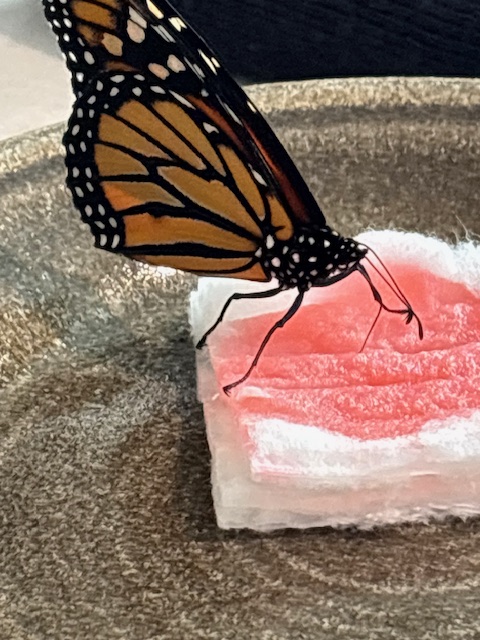
And, of course, we had to determine what to feed him. To make a multi-day trial and error story short, we found that warmish sugar water and fruit punch Gatorade attracted him. Amy took this task on, though I managed to help out some. With a small square of cotton soaked in the sweet, red mixture, he spent his time with us, mostly sitting on a saucer on our kitchen breakfast counter. Monarchs, we learned, taste with their feet and antennae. My wife’s gentle fingers would place him on the saucer in a way to let him get a taste. Then, we’d wait for him to unfurl his proboscis and drink, which sometimes he did greedily, often barely at all. They eat, we found, sparingly, every other day or so, which can get a bit maddening for those watching. After all, our memories were still full of a cat who would barely eat anything, and a dog whose gastric condition had him ravenous at all times. Amy, though, gave the butterfly her attention daily, often hourly.
I told her that I had named him “Bucephalus,” ironically, because he was so fragile. That was the name of Alexander the Great’s battle stallion, a powerful and fiery horse, exactly the opposite of our Monarch. Maybe I was hoping that the name would lend him some strength. I don’t know. All I knew for sure was that I had to watch for him constantly, making sure that I didn’t step on him or drop something carelessly on a surface he chose as a landing place for one of his wobbling flights. One morning as I sat reading the news on my tablet, the less than mighty Bucephalus took off from his saucer and flapped to the top of the refrigerator, appearing to fall behind it. Back there, he would not have room enough to even open his wings, let alone fly. I gasped, hoping that he might come to rest on some water line, cord, or vent on the fridge back. All I could imagine was him getting crushed as I rolled the fridge out into the floor. Both of us held our breath as we pulled the fridge out and found him in the warm dark back there, seemingly okay.
See, by this point, little Bucephalus had taken to spending much time perched on Amy’s shoulder, head, or arm. He would stay with her, sometimes, when she got up and moved around, and at night, watching tv, he perched on her. I never though a human and a butterfly could bond, but Amy and this Monarch did. She told me, then, “His name is Greg,” which was a name that she would sometimes say when she called for Grumpy and Grey. I think it deepened their attachment, though it made me try and detach from him, from simple fear at another loss. I also worried that I would be the cause of a sudden, crushing demise for our little guest. We took precautions everywhere, but he could fly to places that were sources of immediate, deadly danger: a sink full of water; the stove, when we were cooking; the sideboard in the kitchen; or into the open top of a hot floor lamp—which he did once. It sent us scurrying to his rescue.
Greg must have been his name, because he grew even closer to Amy as the days of his short life passed. Some straggler Monarchs, we read, could live much longer that the early crop of butterflies, eight to nine months, rather than three to five weeks. Maybe, we thought, he could over-winter with us, and we could release him in April. It was a good thought.
When he did fly, though, it was towards the window in the kitchen or the living room. Rambling, wobbly jogs through the air, followed by a crash landing. Amy put towels down to soften his landings, give him good purchase. He flew toward daylight, driven by Monarch concerns, I’m sure: migrate and mate. “Do we give him freedom, even though it will kill him?” I asked her.
“I really don’t know,” Amy replied. “If we can keep him alive until spring…”
“Yeah, I know. If…” I said. I wanted to believe it was possible.
Monarch wings, though they look like stained glass, are thin as onion skin and even more delicate. The color comes off like powder if they are mishandled, though Amy knew how to cradle him with tented fingers, keep him whole. Greg, however, would flutter at the window, desperate to get out, so his wings began to tatter on the edges. On a couple of flights across the living room, Greg flew into the Christmas tree, and while it was beautiful to see him hanging in it like an ornament, the process of getting in and out was even harder on his wings. He banged around on the tough, artificial needles and wire branches until one of us could help him out. Once, he fell out of the tree and got wedged between presents on the floor. I guess he missed the padded windowsill on one of his wobbling flights across the room. Amy looked at his tattered condition and said in a quiet voice, “He probably doesn’t have long.”
Just a day or so before Christmas Day, Greg’s posture changed. His abdomen swelled, and we didn’t know why. We read that such things can come from overfeeding or a parasitic infection. The first was doubtful, for he would ignore his syrupy fluid for days. Also, most parasitic infections in Monarchs show up as they leave their chrysalis. He gave up flying and let Amy hold him when offering him food. If a butterfly can be patient, I’d say Greg was. He grew, by turns, more anxious to get out and more willing to sit on Amy’s warm hand. All I could think about was holding Grumpy as the vet eased his pain and put him permanently to sleep.
When Greg’s short live ended, it was sometime on New Years’ Eve. Greg did not make it into 2026. “Five weeks or so is a good run for a Monarch,” I said to Amy. And she agreed, nodding in silence. She laid him in a small gift box with a cotton wool liner, but he couldn’t sit on her shoulder soaking up her warmth. It seemed like a hard way to start the year, but Amy smiled when she remembered all that we had learned about butterflies, though I doubt she or I will be in a hurry to have one live in our house again. Sometimes, I think that sort of caring comes at too high a price.
My dog Grumpy was my best friend, and kind friends tell me that I will see him again, and I pray that it is true. Sometimes, though, I thought of myself as his jailer. I wouldn’t let him do what he wanted, go where he wanted, eat what he wanted. I told myself that my concern for him was born out of love, a need to keep him safe, even from himself, his choices. He never minded or held it against me, either. He was always there for me, for us, with a happy wag and a bark and licks on my face. I watched Amy give that same sort of thing to Greg, as she always had to Grumpy and Grey, but I could not.
Truthfully, I wondered if I am not in the same relationship with God, thinking that I have to do right to be accepted by my master. But that’s some “stinkin’ thinkin’” as folks in Twelve Step programs say. It was more like Grumpy was in the God spot, caring completely, loving without reservation one hapless creature. Amy’s time with Greg was like that too. Her love for him, care for him, led her to think about helping more Monarchs, with an even bigger pollinator garden this coming summer. Our house will be full of flight cages, and they, in turn and in time, will be full of those fat little j-hooks of butterflies to be.
Grey cat was with us for sixteen years, Grumpy for thirteen, and Greg from October to the end of December, 2025. We live in complex dependencies with our pets, and I am often torn by what that says about us as people. Is it loving? Is it just needy? Clearly, they need us—not so much butterflies but dogs and cats. Greg, I think, taught me that I’m not yet ready for another dog or cat to enter my life—certainly not another butterfly. However, watching Amy with Greg taught me that caring about another life is a precious thing, beautiful and fragile as a butterfly’s wings, even if a little tattered. And I think that is worth sharing.
 MJ Downing’s Place
what a heart warming story. Thank you for sharing this beautiful event and how it resonated in your life.
Pax
LikeLike
I enjoyed hearing about Bucephalus/Greg from you and Amy and now I have loved reading this beautiful account of his life. He loved and was loved. Thank you.
LikeLike